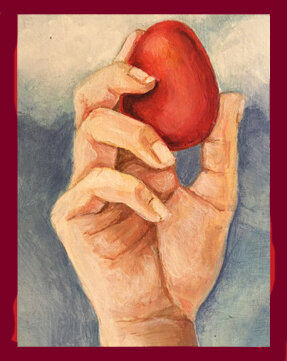

“I experience the creative process as a form of prayer.
It is my sanest response to the world.
It keeps me whole and connects
me
to the mystery.”
—Sue Ellen Parkinson
For over forty years, I have been interested in how deeply imagery influences our perceptions of ourselves and of one another.
I began my career as an illustrator for health educators who produced medical handouts for clinics. Through field testing, we discovered that images depicting respectful, equitable interactions between people elicited a sense of trust, a felt bond with the reader, and a greater willingness to engage with the text.
This work ignited a compelling realization: through creating positive imagery, I could connect with others and help to heal, or at least comfort them. Perhaps, in some small but meaningful way, imagery could strengthen the most humane aspects of who we are.
As I grew older, I became increasingly aware of how women and people of color are often negatively depicted or marginalized. I was struck by how narrow and limiting society’s definition of what makes a woman valuable or worthy of respect had become, and by the profound absence of imagery depicting women as they age. In my own paintings, I began intentionally working toward greater inclusion.
In my late fifties, I fell in love with the traditional Mexican folk art forms of retablos and milagros. I was—and remain—deeply moved by the idea of art as an expression of prayer and gratitude.
Initially, I painted retablos of local friends and family—people I have come to call “Extraordinary Ordinaries.” Unlike traditional retablos, these works did not give thanks to a specific saint. Instead, they honored the divine qualities I perceived in everyday people. Viewers were often profoundly moved by these retablos. I developed a deep respect for this work, which inspired me to study the traditional form more deeply and to explore the lives of Christian saints and mystics—figures I had previously felt an aversion toward.
A deep mystery led me first to Mary Magdalene. The more I learned, the more she seemed to embody the countless women whose contributions have been diminished, or erased from historical narratives.
Initially I imagined I would paint a single work of Magdalene and move on. Instead, this early exploration of the Sacred Feminine opened an entirely new path that has transformed my life. Although I have long considered myself spiritual, I held a deep skepticism toward organized religion. I’ve come to recognize how thoroughly patriarchal conditioning had shaped my life and perceptions. I had lived under the illusion that I was somehow free of it, but it is no easy thing to extricate oneself from a lie that pervades your entire culture.
Untangling oneself from such a system is like being caught in a berry bush—it happens slowly, thorn by thorn. With each painting of the Sacred Feminine, I feel myself removing a thorn, and becoming more free.
My work continues to evolve towards creating a more expansive vision of women—of all races, ages, and backgrounds—honoring their unique gifts and illuminating the vast, complex beauty of their humanity, a humanity that has always been worthy of respect and equality.
I hope my paintings act as seeds for a kinder, more truthful future.
• • • •
• Faculty member of, Mythica: www.mythicacommunity.org
• CoHost of The Little Gifts Podcast
• Contact me for public presentations, either in person or online.
• Teaches SoulCollage, and Visio Divina.
To contact Sue Ellen Parkinson:
Call or text (707) 354-3555, or email: sueellenparkinson@gmail.com